





Serotonergic Psychedelic Mechanism
Our approach to developing novel therapeutics is inspired by decades of psychedelic research demonstrating promising results for a variety of mental health conditions. Current treatments such as serotonin reuptake inhibitors (SSRIs) are associated with limited efficacy and harmful side effects and require continuous dosing. Classic psychedelics have been shown to produce unprecedented durable efficacy in a single dose. Specifically, RCT studies demonstrate the benefits of psilocybin in depression after one dose. Our focus is to advance the initial discoveries of 5HT2A compounds and develop new agents with safe, effective profiles.
We are advancing our lead candidate, luvesilocin, a potential best-in-class, short duration, patented prodrug of 4-OH-DiPT, a psilocybin-like compound. Luvesilocin targets the serotonin 2A receptor (5HT2AR), which is the recognized target for the antidepressant effects of psychedelic compounds.
With our exclusive rights to luvesilocin, we can evaluate luvesilocin in various underserved mental health disorders and are actively investigating its use in additional indications susceptible to being treated with a 5HT2A agonist molecule.
INDICATIONS
Postpartum Depression
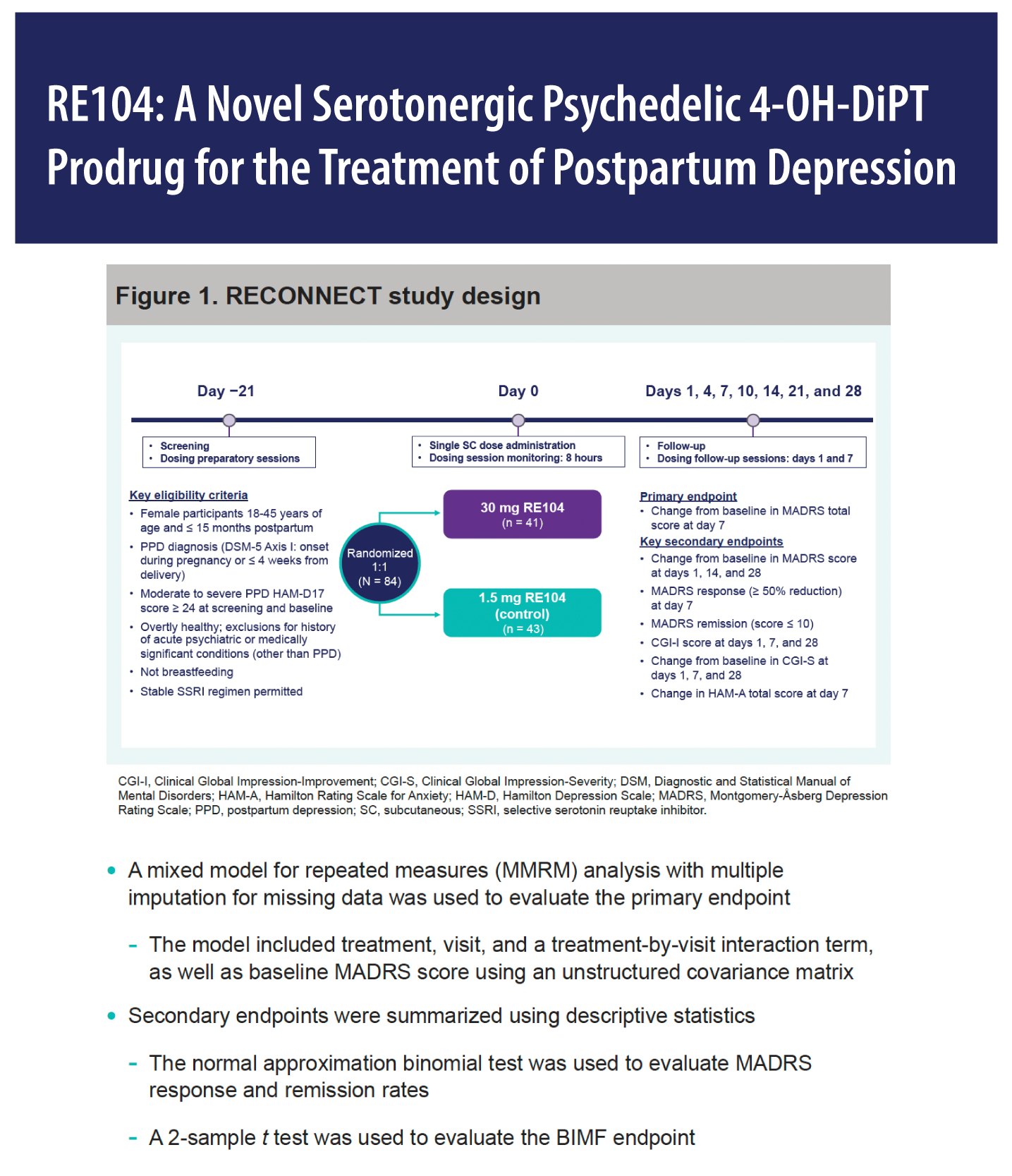
In August 2025, Reunion announced positive topline results from the RECONNECT Phase 2 clinical trial in postpartum depression (PPD). The study met its primary endpoint, demonstrating a statistically significant and clinically meaningful reduction from baseline in the Montgomery-Åsberg Depression Rating Scale (MADRS), a key measure of depressive symptoms, as well as a robust safety tolerability profile. Additionally, data from RECONNECT suggest that patients reach discharge readiness rapidly, within four hours of treatment, consistent with luvesilocin’s differentiated pharmacology.
Also in August, Reunion announced preliminary data from a Phase 1 clinical lactation study, which suggest that mothers may be able to return to breastfeeding rapidly following luvesilocin treatment. Based on these data, the FDA granted luvesilocin Breakthrough Therapy Designation (BTD) for PPD. Reunion has aligned with the FDA on a registrational path in PPD, and plans to advance luvesilocin into a single pivotal Phase 3 clinical trial for the treatment of PPD in 2026.
PPD is a major form of depression that is estimated to affect about 15% of new mothers within the first year of giving birth, with nearly 500,000 women in the U.S. diagnosed annually. Women suffering from PPD often experience significant changes in mood, appetite and sleep contributing to feelings of hopelessness, lack of concentration, loss of energy, poor self-esteem and maternal disinterest.
The only viable regulatory approved therapy indicated for PPD has side effects that include sedation (with Black Box warning) and potential addiction and embryo-fetal toxicity. SSRIs, which are often prescribed off-label, take a long time for onset and only show limited efficacy, representing a concern for the safety, well-being and long-term development of the child.
While there have been recent developments in treatment options for PPD, there continues to be a significant unmet need for a solution that offers a faster onset of action, greater efficacy after only a single dose, with limited interruption in breast feeding and a faster return to normal daily activities.
Adjustment Disorder
Reunion is also evaluating luvesilocin in the REKINDLE Phase 2 clinical trial as a potential treatment for adjustment disorder (AjD) in cancer and other medical illnesses.
AjD is a mental health condition defined as a disproportionate reaction to a stressful life event or change, which impacts the ability to function and is characterized by depression, anxiety and/or other behavioral and mood disturbances. Serious medical illnesses are known to be a key precipitant of AjD; it is estimated that approximately 500,000 people in the United States are diagnosed with AjD each year following a medical or health-related stressor, including 6-35% of cancer patients. A global survey of psychiatrists by the World Health Organization revealed that adjustment disorders play an enormous role in healthcare utilization; ranked 7th among 44 psychiatric categories they managed at least once a week in their practice.
Depressive and anxiety symptoms in medically ill patients with AjD can be associated with poorer medical outcomes, treatment compliance and quality of life as well as increased health care utilization. Current treatments for AjD are not consistently effective, and there are no therapies presently approved by the FDA for its treatment.
AjD in cancer patients is one of the initial indications studied by researchers on psychedelic treatment and several clinical trials indicate the potential for rapid and meaningful improvements in depression and anxiety with durable changes in attitude and behavior.
Reunion believes there is a significant unmet need for a rapid acting solution for these medically ill patients to positively impact treatment compliance, hospitalization time and improved quality of life.
Generalized Anxiety Disorder
Reunion also plans on evaluating luvesilocin in the RECLAIM Phase 2 clinical trial as a potential treatment for generalized anxiety disorder (GAD). Reunion expects clinical data from the RECLAIM Phase 2 trial, which will evaluate the safety and efficacy of luvesilocin in adults with GAD, in the second quarter of 2027.
GAD is a mental health condition characterized by persistent, excessive and uncontrollable worry and anxiety, often about everyday situations, which cause distress and can interfere with daily functioning. GAD can manifest in a variety of physical, as well as psychological symptoms, including sleep disturbance, gastrointestinal issues, shortness of breath, chest discomfort, headaches and pain.
It is estimated that GAD affects 6.8 million adults in the United States annually. If left untreated, GAD can increase the likelihood of developing secondary disorders, including major depressive disorder (MDD) and other anxiety disorders, and increase the risk of suicide.
Current treatment options for GAD include medications like selective serotonin reuptake inhibitors (SSRIs) and serotonin and norepinephrine reuptake inhibitors (SNRIs), as well as psychosocial treatments such as Cognitive Behavioral Therapy (CBT). Benzodiazepines and antipsychotics are also commonly prescribed. As many as half the patients treated for GAD fail to respond to initial treatment, and only a minority achieve remission.
There remains a broad unmet need for safe and effective, fast-acting therapies for GAD, as current treatment options have significant limitations, which reduce their effectiveness and patient adherence.
OUR PIPELINE
Luvesilocin
(Psychedelic)


READ MORE
Reunion is advancing luvesilocin into a pivotal Phase 3 clinical trial as a potential treatment for women suffering from postpartum depression (PPD), which is a major form of depression that is estimated to affect about 15% of all mothers of newborns. Women suffering from PPD often experience significant changes in mood, appetite and sleep contributing to feelings of hopelessness, lack of concentration, loss of energy, poor self-esteem and maternal disinterest.

READ MORE
We are evaluating luvesilocin in the REKINDLE Phase 2 clinical trial as a potential treatment for adjustment disorder (AjD) in cancer and other medical illnesses. AjD is a mental health condition defined as a disproportionate reaction to a stressful life event or change, which impacts the ability to function and is characterized by depression, anxiety and/or other behavioral and mood disturbances. Serious medical illnesses are known to be a key precipitant of AjD; it is estimated that approximately 500,000 people in the United States are diagnosed with AjD each year following a medical or health-related stressor, including 6-35% of cancer patients. A global survey of psychiatrists by the World Health Organization revealed that adjustment disorders play an enormous role in healthcare utilization; ranked 7th among 44 psychiatric categories they managed at least once a week in their practice.

READ MORE
Reunion plans to evaluate luvesilocin in the RECLAIM Phase 2 clinical trial as a potential treatment for generalized anxiety disorder (GAD). GAD is a mental health condition characterized by persistent, excessive and uncontrollable worry and anxiety, often about everyday situations, which cause distress and can interfere with daily functioning. It is estimated that GAD affects 6.8 million adults in the United States annually. If left untreated, GAD can increase the likelihood of developing secondary disorders, including major depressive disorder (MDD) and other anxiety disorders, and increase the risk of suicide.
RE245
(Non-Psychedelic)


Luvesilocin
Reunion’s lead product candidate, luvesilocin, is a proprietary, potential best-in-class, patented prodrug of 4-OH-DiPT designed to deliver a short psychedelic experience compared to longer experience duration psychedelics like psilocybin or LSD.
In the RECONNECT Phase 2 clinical trial in adult female patients with moderate-to-severe PPD, luvesilocin demonstrated a robust decrease in depression symptoms and was generally well-tolerated, consistent with previously reported Phase 1 safety data with luvesilocin and other psychedelic agents. Additionally, patients in RECONNECT reached discharge readiness rapidly, consistent with luvesilocin’s differentiated pharmacology. Based on these data, the FDA granted luvesilocin BTD for PPD. Reunion has aligned with the FDA on a registrational path in PPD, and plans to advance luvesilocin into a single pivotal Phase 3 clinical trial in 2026.
In tandem with announcing topline results from RECONNECT, Reunion also shared preliminary data from its Phase 1 clinical lactation study, an open-label, single dose study evaluating the concentration of luvesilocin and its major metabolites in breast milk and plasma of healthy lactating women. Results from the study suggest that mothers who wish to return to breastfeeding following luvesilocin treatment may be able to do so with limited interruption and FDA feedback supports the enrollment of women who are actively breastfeeding into Reunion’s planned Phase 3 trial.
In addition, Reunion is evaluating luvesilocin in the REKINDLE Phase 2 clinical trial, a randomized, double-blind, parallel-group, dose-controlled study in AjD in cancer and other medical illnesses.
Reunion also plans on evaluating luvesilocin in the RECLAIM Phase 2 clinical trial, a multicenter, randomized, double-blind, active dose-controlled study in adult GAD patients. Phase 2 clinical data from the study is expected in the second quarter of 2027.

RE245
RE245 is a discovery-stage, non-psychedelic asset, for application in chronic treatment paradigms and indications. RE245 is structurally similar to classic psychedelics and is designed as an orally-bioavailable 5HT2A agonist, which provides therapeutic mental health benefits for chronic conditions without causing hallucinations or cardiotoxicity.
PUBLICATIONS



BACKGROUND PUBLICATIONS
Barrett FS, Johnson MQ, Griffiths RR. Validation of the revised Mystical Experience Questionnaire in experimental sessions with psilocybin. J Psychopharmacol. 2015;29(11):1182-1190. Read more
Haijen E, Kaelen M, Roseman L, et al. Predicting responses to psychedelics: A prospective study. Front Pharmacol. 2018;9:897. Read more
Hirschfeld T and Schmidt TT. Dose-response relationships of psilocybin-induced subjective experiences in humans. J Psychopharmacol. 2021;35(4):384-397. Read more
Klein AK, Chatha M, Laskowski J, et al. Investigation of the structure-activity relationships of psilocybin analogues. ACS Pharmacol Transl Sci. 2021;4(2):533-542. Read more
Waters K. Pharmacologic similarities and differences among hallucinogens. J Clin Pharamcol. 2021;61(S2):S100-S113. Read more
Yaden DB and Griffiths RR. The subjective effects of psychedelics are necessary for their enduring therapeutic effects. ACS Pharmacol Transl Sci. 2021;4(2):568-572. Read more